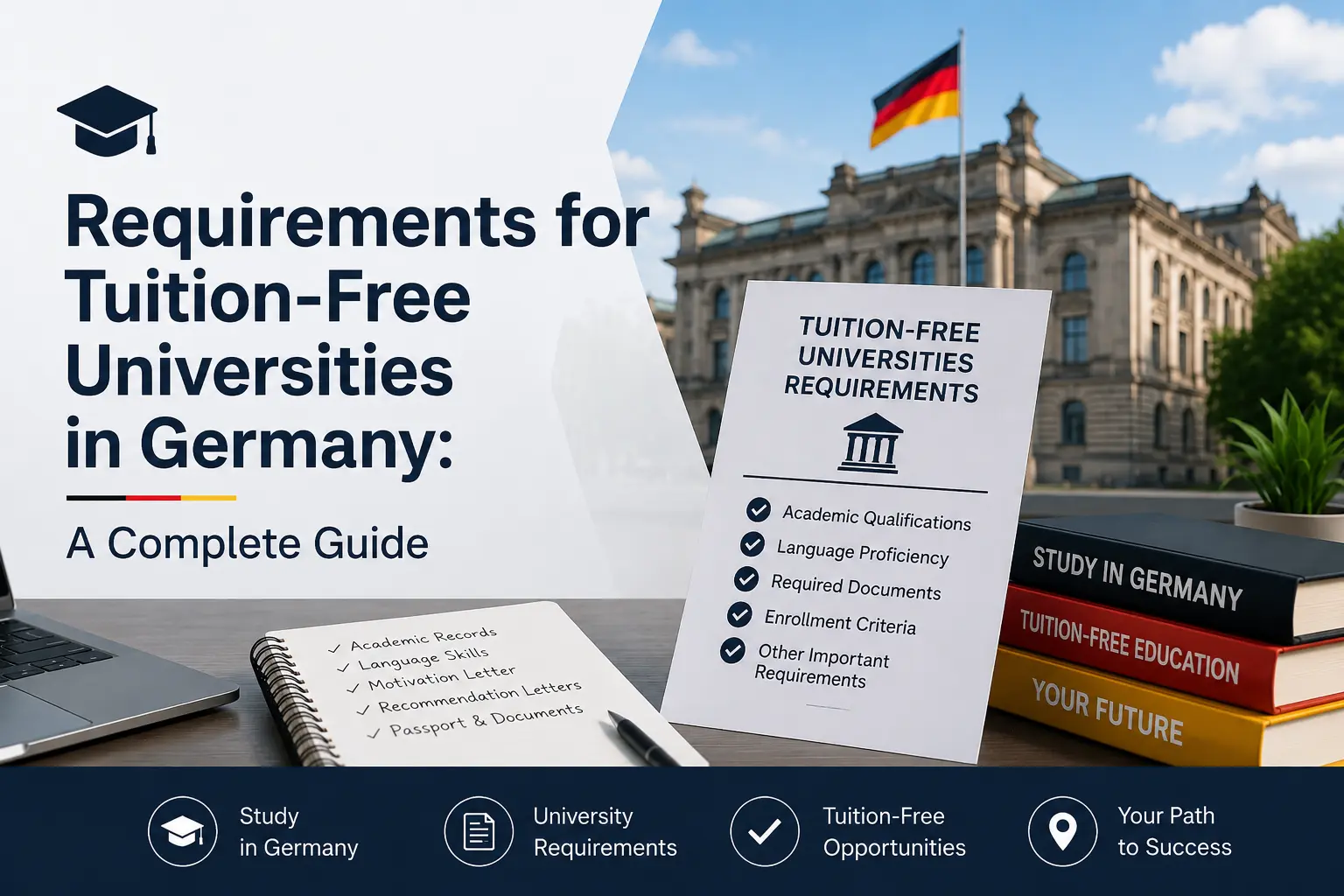
Requirements for Tuition-Free Universities in Germany: A Complete Guide
One of the biggest reasons Germany is a top destination for international students is its unique higher education policy: most public universities offer tuition-free education. While you still have to cover your living expenses and a small semester contribution, you don’t have to pay thousands of euros for tuition.
However, “free” does not mean “easy to get into.” German public universities maintain high standards and strict admission criteria.
In this guide, we will break down the essential requirements you must meet to secure a spot at a tuition-free university in Germany.
1. Academic Requirements: Higher Education Entrance Qualification (HZB)
To study at a German university, your school-leaving certificate must be recognized as equivalent to the German Abitur. This qualification is called the Hochschulzugangsberechtigung (HZB).
- Direct Admission: If your high school diploma (such as International Baccalaureate, AP scores, or specific national diplomas plus university entrance exams) meets German standards, you can apply directly to a Bachelor’s program.
- Indirect Admission (Studienkolleg): If your high school diploma is not automatically recognized, you will need to attend a one-year preparatory course in Germany called a Studienkolleg and pass the Feststellungsprüfung (FSP) exam before starting your degree.
2. Language Proficiency Requirements
Even though tuition is free, you must prove you can follow the lectures.
For German-Taught Programs (Most Common)
The vast majority of free Bachelor’s degrees are taught in German. You generally need a C1 level of German proficiency at the time of official enrollment. Accepted certificates include:
- TestDaF (usually a score of 4×4)
- DSH-2
- Goethe-Zertifikat C2
- Telc Deutsch C1 Hochschule
For English-Taught Programs
Germany offers an increasing number of tuition-free Master’s degrees (and some Bachelor’s) taught entirely in English. For these, you will need to prove an English B2/C1 level via:
- IELTS Academic (usually 6.5 or higher)
- TOEFL iBT (usually 80-90 or higher)
3. Financial Proof: The Blocked Account (Sperrkonto)
While the university itself charges 0 Euros in tuition, the German government requires proof that you can support your daily life. To get your student visa, you must open a Blocked Account (Sperrkonto).
You must deposit the legally required amount set by the government into this account. Once you arrive in Germany, the bank will release a fixed monthly allowance to cover your rent, health insurance, food, and learning materials.
4. Health Insurance (Krankenversicherung)
You cannot enroll in any German university without proof of valid health insurance. Once you are admitted, you must register with a statutory German health insurance provider (like TK, AOK, or Barmer) or get an approved private insurance plan if you are over 30 or doing a preparatory language course.
Ready to Apply to a Tuition-Free University?
Meeting all these criteria, formatting your CV according to German standards, and handling applications through Uni-Assist can be a complex puzzle. Missing a single requirement could cost you a full semester of waiting.
At INSTAK, we evaluate your academic background, help you find the right tuition-free programs, and manage your entire application process from A to Z.
[Contact Our Team Today] and let’s map out your free education journey in Germany!